Rich Dad’s Conspiracy of the Rich: The 8 New Rules of Money
Rich Dad’s Conspiracy of the Rich: The 8 New Rules of Money
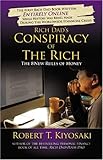
- ISBN13: 9780446559805
- Condition: NEW
- Notes: Brand New from Publisher. No Remainder Mark.
In late January, 2009, Robert Kiyosaki launched CONSPIRACY OF THE RICH – a free online book which was written in serial basis to help people understand how the current recession came about, and what they need to learn on how to survive through the coming rough years.
An unprecedented publishing event for Kiyosaki and The Rich Dad Company, CONSPIRACY OF THE RICH is an interactive, “Wiki-style” project in which Kiyosaki has invited feedback, commentary, and questions from readers across th
Rating:  (out of 75 reviews)

List Price: $ 12.99
Price: $ 6.94
More Money News Products


Review by javajunki for Rich Dad’s Conspiracy of the Rich: The 8 New Rules of Money
Rating:
First of all, I’m not a Kiyosaki fan…his style of writing just tends to annoy me however, he is one of those authors that is able to effectively communicate with the average person and often has one or two gems that make it worthwhile to read his books. Having said that, this book is a bit different than his others both in terms of content and style. It is primarily compiled from his website which by this point, is both a work in progress as well as a day by day breakdown of the current economic crisis unfolding as history. The book contains comments by readers of the website/blog as well as more traditional insight and commentary by Kiyosaki et al.
As a college instructor as well as business writer, I’m quite familar with authors that “try out” or compose a book from class notes, lectures, journal submissions and articles etc…but few have used an online format as a pure marketing ploy to generate both interest and actual content. I suspect it takes a highly recognized name and a major economic melt-down to pull it off. Sales of this book will certainly determine if it is pure genius or merely a gimmick.
Aside from the collaborative nature of the book, the actual writing retains the same consumer friendly, conversational tone found in former “Rich Dad” books with the very pleasant lack of constant reference to the “dads” which was a personal pet peeve. Personally I found this to be more readable than most and equally interesting.
The author departs from the prior “real estate” emphasis into a much broader investment perspective which includes precious metals and other assets, proper use of debt, information and much more. I was fairly impressed by both the rationale and future trends as well as the very “do-able” information presented. It is obvious the author has taken time to create something within the grasp of average Americans by first providing a framework for safety then moving beyond to creating choices for potentially more rewarding investments. At each step of the way a solid rationale is provided…whether one agrees or disagrees, it is valuable to reflect upon where the author is “coming from” in order to make up your own mind as to the validity of the position or not.
Readers that enjoyed Ron Pauls’ recent ‘End the Fed” will be delighted by the straight-forward discussion about the status of the government, Fed and more in this recent book. Kiyosaki doesn’t mince words this time around and does so in a purely equitable manner that doesn’t offend – but is designed to enlighten the reader to the dangers surrounding them at every turn.
More savvy investors may not find a lot new however, those searching for a fresh start or trying to make sense of the current economic crisis and future financial trends in an easy to understand way will truly appreciate this book. There is overlap from prior books but also a surprising amount of newer or revised content that is well worth the time of former readers to review.
Bottom line…a surprisingly good book.
Review by Marvin D. Pipher for Rich Dad’s Conspiracy of the Rich: The 8 New Rules of Money
Rating:
This remarkable book is filled with factual information, both current and historical, and although that information may discourage or frighten some readers the book is written in such a casual style that it is almost as if its story is being told by your best friend. Only, in this case your friend actually knows what he is talking about. It is a great read, and the information it conveys is simply too valuable to miss. I only wish such books had been available forty or fifty years ago.
In any event, if you are a product of America’s public school system, you may very well have asked yourself, as I once did: “What have I learned in my twelve years of school that will help me get a job?” That’s certainly an interesting question, but, strangely enough, the answer is far less important than the question itself. For that question reveals a mindset that has been instilled in America’s children by our public education system, by conventional wisdom, and, in all probability, by almost every student’s parents for generations. Namely: Get an education, get a job, work hard, buy a house, save for the future, and someday you will be able to retire and live happily ever after.
That mindset, according to this book’s author, has doomed generations of Americans to a lifetime of hard work with little chance success, leading many to someday ask themselves: “Why is it that I have a good education and work hard at my job, but I never seem to be able to get ahead?” The answer, again according to this author, is that, despite the fact that America is a capitalist society, our public schools only train our children to be good employees, good soldiers, professionals, and small business owners, but teach them nothing about money and finance or how to properly invest and prosper in a capitalist system.
This book seeks to break that mindset by encouraging its readers to change their attitudes from “I can’t do that” to “How can I do that” and offers fairly specific suggestions and guidelines as to how individual successes might be achieved. The trick, Mr. Kiyosaki avers, is to first change your way of thinking, then study your chosen direction, and finally work toward getting out of what he terms the “Employee/Small Business” (E/S) quadrants, in which the odds are stacked against you; and into the “Big Business/Investor” (B/I) quadrants wherein lies greater opportunity, lower taxes, cash flow without labor, and the opportunity to exploit those in the E/S quadrants.
After reading this book, I came to the conclusion that it is invaluable, especially to young adults, and should be read by every thinking American. I also came to the conclusion, however, that the book’s title is something of a misnomer. It should really be entitled “The Conspiracy of the Super Rich,” for they, the politicians they control, and the heads of America’s largest banks are the ones who perpetrated and carry on the conspiracy.
So, yes, Virginia, there is a conspiracy of the rich, and if you reside in the E/S quadrants, as virtually all of us do, you are one of their Santa Clauses. But, strangely enough, “the rich” aren’t really those we are led to believe they are. They aren’t those making over $200,000 per year, who presumably should be punished for it, or minor millionaires. They are the anonymous “Super Rich” who make the rules and control the game. And they are well above it all.
Review by Get Rich or Die Trying for Rich Dad’s Conspiracy of the Rich: The 8 New Rules of Money
Rating:
Considering R. Kiyosaki is a wealthy man from his other books he is really providing a patriotic service to our country. As a student of the banking system and money in general, he does expose the fundamentals of who “prints” our money and to the private organization a large part of our federal taxes feed.
Because of his platform and fame, he really is exposing himself to risk on this one. He’s really connecting the dots. I’m sure those in control will not appreciate this being in the mainstream. He clearly states that change isn’t coming with Obama (or any President, rep. or dem) and we’ll have to be the change. This book operates on this fundamental… in order to break the rules, you have to know them well. You need to know the fallacies of the “old” rules of money before you can apply the “new” rules.
This book will open your eyes to what money really is… shouldn’t you know what most of the world goes to work for every day?
Pick this book up while you still can.
Thanks Robert for all of your books. My life has never been the same since reading Rich Dad Poor Dad. He has steered me clear of the “Rat Race” pitfalls most people fall into.
Review by Eddie Tennison for Rich Dad’s Conspiracy of the Rich: The 8 New Rules of Money
Rating:
I personally met Robert in 1991. I’ve always considered him a mentor who has good information to share.Although I have not always agreed with him 100 per cent, I think his essential ideas are very sound. I’ve followed his writing career with interest over the years. I haven’t read every one of his books, but I thought Rich Dad, Poor Dad was great, and deserved to be such a huge bestseller.
Those who are fans of Robert’s investing techniques will not find a lot of new ideas here for making money. The really important information in this book has more to do with the unholy alliance of the Federal government with the big banking houses — and how that is impacting our economy now, and in the near term future.
It also takes a critical look at the history of our educational system,examining the WHY of”why don’t the schools teach much about managing money?”.
This book is a serious eye-opener, and I hope Robert’s fame results in a lot of people reading it.
Review by Wyote for Rich Dad’s Conspiracy of the Rich: The 8 New Rules of Money
Rating:
This book is a scam. Most of the information is good enough, but it promises some new rules, and there are none.
What are the 8 rules?
1. You don’t need money to make money. You only need ideas. Hmmm. It might be true if you can start a google, but most people need something to invest. He doesn’t talk about Google, he talks about shorting shares. You need money to do that. So he’s just full of crap here. However, someone with a good business idea can raise capital – that’s true, and that would be a good point, a good example. Not new by any means, but at least not BS.
2. Learn how to use debt. He distinguishes between consumer debt and leveraged investment, which is right, but not new. He also fails to give any warning about the hazards of leverage. You’d think, given the events of the past year, it might’ve deserved a mention.
3. Control cash flow. Keeping a budget is a new idea?
4. Prepare for bad times. My grandparents lived through the Great Depression. They knew this. Nothign new here.
5. The need for speed. RK means you have to act quickly. Hasn’t everyone noticed this? Remember all the globalization hype? Anyway, someone should ask Warren Buffet about speed.
6. Learn the language of money. Did anyone need to be told this?
7. Life is a team sport – choose your team carefully. Pure platitude.
8. Get educated about finance. This “rule” must be 300 years old, and if you couldn’t think of it for yourself, no book – let alone this one – will help you.
All in all, don’t spend your money on this book. Find a book with real information and less salesmanship.
Let me recommend instead one of the all-time great books on personal finance: Your Money or Your Life: 9 Steps to Transforming Your Relationship with Money and Achieving Financial Independence: Revised and Updated for the 21st Century.